World
Bangladesh Mourns Death of Khaleda Zia, Nation's First Female Prime Minister
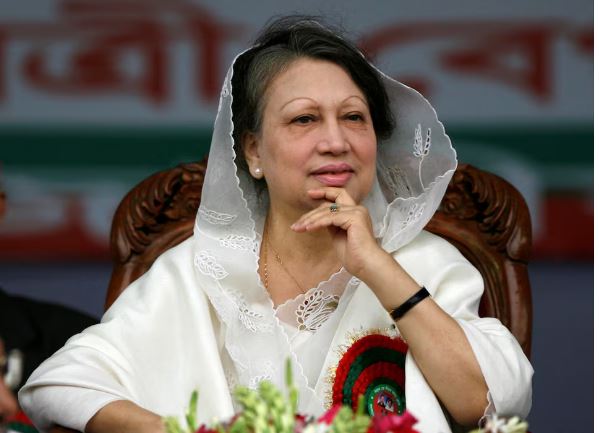
Bangladesh is in deep mourning following the death of Khaleda Zia, the country’s first female prime minister
and a towering figure in its modern political history. She passed away on Tuesday at the age of 80, after battling
multiple chronic illnesses, her political party, the Bangladesh Nationalist Party (BNP), confirmed.
Zia’s death marks the end of a political career that spanned more than three decades, defined by historic achievements, fierce rivalries, and moments of intense national controversy.
Zia had suffered from a combination of serious health conditions, including advanced liver cirrhosis, arthritis, diabetes, and recurring heart and chest complications.
Her deteriorating health had necessitated extended treatment both at home in Dhaka and abroad, including a four-month stay in London earlier this year before she returned to Bangladesh.
Her prolonged illness had limited her direct involvement in politics in recent years, but she remained a symbolic leader for millions of supporters.
Khaleda Zia’s rise to the premiership was extraordinary in both national and regional terms.
She first became Bangladesh’s prime minister in 1991, following a landmark election that restored parliamentary democracy after years
of military and autocratic rule. Her ascent represented not only a political milestone but also a social one: she became one of the earliest women
in a Muslim-majority country to hold the office of prime minister.
Her political career was closely linked with her late husband, Ziaur Rahman,
a former army officer who became president of Bangladesh before being assassinated in 1981. She assumed leadership of the BNP, the party founded by her husband,
and successfully transformed it into a dominant force in national politics. Her leadership style combined political pragmatism with a strong populist appeal,
often emphasizing nationalism, economic development, and social welfare policies.
During her first tenure, Zia helped oversee Bangladesh’s transition from a presidential system to a parliamentary democracy.
Her government prioritized administrative reforms, educational expansion, and early economic liberalization policies, while simultaneously navigating the complex dynamics of
a nation still recovering from the trauma of independence and political unrest.
Read
Full Story