Tesla Falters as China’s BYD and EV Rivals Close In, Redrawing the Global Power Map
A bruising delivery miss reveals how quickly the balance of power is shifting — and how exposed EV leadership has become
Ekolense International Desk | 2026-01-03 | Automotive & Business
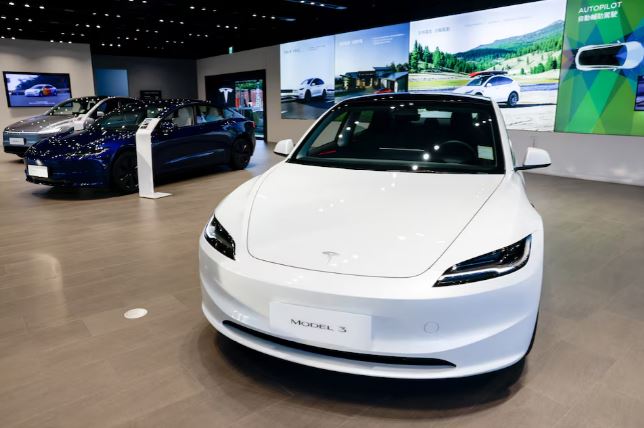
Tesla faces mounting pressure from BYD and European automakers as the EV market enters a more competitive phase.
For much of the past decade, Tesla’s dominance of the electric vehicle market felt inevitable. The company didn’t merely participate in the EV revolution — it defined it, setting the pace while competitors struggled to catch up.
That sense of inevitability is now fading. Tesla’s latest quarterly delivery figures have delivered a jolt to investors and industry watchers alike, exposing vulnerabilities that extend well beyond a single earnings cycle. The numbers point to a deeper transformation underway in the global EV market — one where Tesla is no longer racing alone at the front, but fighting to defend territory as rivals close in from every direction.
In the final quarter of 2025, Tesla delivered just over 418,000 vehicles, a sharp year-on-year decline that came in below market expectations. On paper, it is a disappointing result. In context, it raises a more unsettling question: has the world’s most influential EV maker entered a phase where growth can no longer be taken for granted?
From Market Leader to Market Battleground
Tesla’s rise was built on a powerful combination of first-mover advantage, brand loyalty, and technological ambition. For years, it enjoyed a commanding lead in battery technology, software integration, and manufacturing scale — advantages that allowed it to dominate while traditional automakers hesitated.
That dominance is now under sustained attack. China’s BYD, once viewed primarily as a domestic player, has emerged as Tesla’s most formidable challenger. Backed by aggressive pricing, government support, and relentless expansion, BYD has overtaken Tesla in total EV sales by volume, reshaping the global leaderboard.
Beyond China, European automakers such as Volkswagen, BMW, and Mercedes-Benz have accelerated their electric ambitions. Once cautious and incremental, they are now flooding the market with electric models across multiple price points — from premium sedans to mass-market SUVs — directly targeting Tesla’s core segments.
What was once a clear hierarchy has become a crowded battlefield. Tesla still commands immense brand power, but it no longer controls the tempo of the race.
This shift represents a critical inflection point for the EV industry. The market is moving from early adoption into a more mature, competitive phase — one where innovation alone is no longer sufficient to guarantee leadership.
Demand Weakness Tightens the Noose
The intensifying rivalry could not have come at a worse time. Global demand for electric vehicles has softened, weighed down by macroeconomic pressures that are reshaping consumer behavior. Higher interest rates have pushed up the cost of auto financing, discouraging buyers from committing to big-ticket purchases. For many consumers, the premium pricing of EVs — even with falling battery costs — remains a hurdle.
In the United States, the expiration of key federal EV tax credits has removed a powerful incentive that once helped drive Tesla’s sales momentum. Buyers who previously relied on subsidies to offset higher upfront costs are now more hesitant, particularly in a climate of economic uncertainty.
Europe tells a similar story. Slowing growth and inflationary pressures have made consumers more price-sensitive, triggering aggressive discounting across the EV sector. Automakers are now locked in price wars that threaten margins and profitability.
Tesla has responded with familiar tactics: price cuts, promotional incentives, and the rollout of lower-cost variants of its best-selling models. These moves have helped defend market share, but they come at a cost. Each price reduction raises concerns about margin erosion and long-term earnings power.
The strategy keeps Tesla competitive — but no longer comfortably ahead.
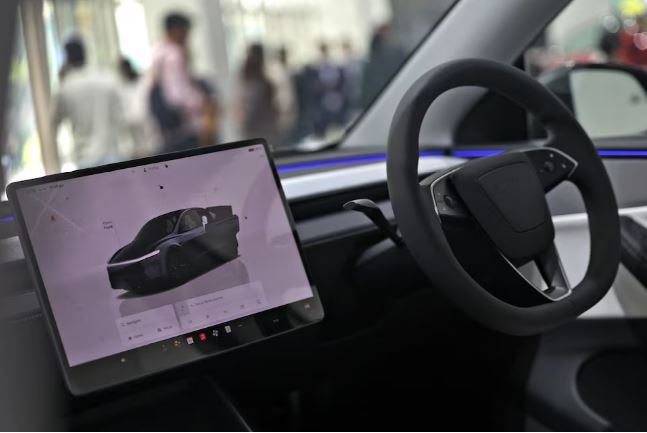
Tesla faces mounting pressure from BYD and European automakers as the EV market enters a more competitive phase.
Rivals Advance with Structure, Not Spectacle
While Tesla grapples with slowing deliveries, its competitors are advancing with discipline and scale. BYD’s greatest strength lies in its vertical integration. By manufacturing its own batteries and key components, the company has achieved cost efficiencies that few rivals can match. This allows BYD to price aggressively without sacrificing margins — a decisive advantage in a market increasingly driven by affordability.
Legacy automakers, long criticized for being slow to adapt, are also finding their footing. Companies like Volkswagen and BMW are leveraging decades-old supply chains, established dealer networks, and deep relationships with regulators to scale EV production more smoothly than many expected.
Just as importantly, they bring something Tesla lacks: familiarity. For cautious consumers transitioning from internal combustion engines to electric vehicles, trusted brands and local service networks matter — especially in uncertain economic times.
The result is a harsher reality for Tesla. The technological gap it once enjoyed is narrowing, and the competitive moat that protected its dominance is steadily shrinking.
Beyond Cars: Tesla’s Long Game Under Pressure
Despite the delivery setback, Tesla’s story is far from one-dimensional. The company continues to position itself as more than an automaker. Its energy storage and generation business posted record deployments during the quarter, offering a rare bright spot in an otherwise challenging report. That segment reflects Tesla’s broader vision of becoming a key player in the global energy transition.
Investors also remain focused on Tesla’s longer-term bets: autonomous driving, artificial intelligence, and robotics. These initiatives have fueled Tesla’s valuation for years, based on the promise that the company could redefine transportation and automation beyond traditional car sales.
But those ambitions remain largely unproven at scale. Full autonomy has yet to materialize, regulatory hurdles remain significant, and monetization timelines are uncertain.
For now, the pressure Tesla faces is immediate — and it is concentrated in the core automotive business that built its empire.
What Comes Next for the EV Race
Attention now turns to Tesla’s upcoming earnings report, which is expected to provide deeper insight into how competition and weakening demand are affecting margins and profitability. Analysts will be watching closely for signs that Tesla can stabilize deliveries without further sacrificing earnings. They will also scrutinize guidance for 2026, searching for evidence that demand can recover in a market increasingly defined by choice, price sensitivity, and competition.
More broadly, Tesla’s struggles reflect a wider shift across the EV industry. The era of explosive, subsidy-driven growth is giving way to a tougher phase — one where scale, cost control, and resilience determine success.
In this environment, being first no longer guarantees being best.
Tesla’s latest delivery stumble is more than a disappointing quarter — it is a warning signal for the entire electric vehicle sector. As rivals accelerate and consumers grow more cautious, the age of effortless EV dominance is ending.
The industry is entering a new chapter, defined not by pioneers alone, but by survivors.
For Tesla, the challenge ahead is clear: adapt to a more crowded, price-sensitive market — or risk becoming just another competitor in a race it once led.
What happens next will not only shape Tesla’s future, but determine who truly controls the electric road ahead.





















Comments