The Court of Appeal rules that Nnamdi Kanu failed to prove claims of torture, intimidation, and denial of fair treatment while in DSS custody.
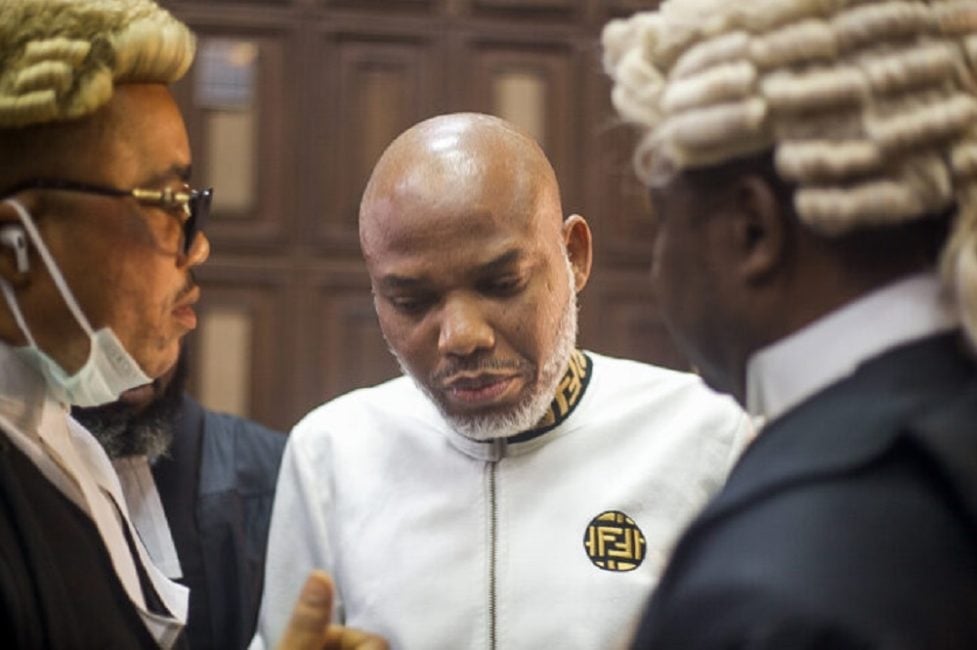
The Court of Appeal in Abuja dismissed Nnamdi Kanu’s rights violation suit against the DSS and government officials.
The Court of Appeal rules that Nnamdi Kanu failed to prove claims of torture, intimidation, and denial of fair treatment while in DSS custody.
The legal battle involving Nnamdi Kanu, leader of the Indigenous People of Biafra, took another decisive turn as the Court of Appeal in Abuja dismissed his suit alleging that the Department of State Services violated his fundamental human rights. The court’s verdict, which has already ignited fresh conversations across political, legal, and social circles, reaffirmed the earlier ruling of the Federal High Court. According to the appellate court, Kanu could not substantiate the claims of torture, intimidation, degrading treatment, denial of legal access, or any other violation he alleged took place during his detention.
From the moment the suit was filed, the case drew nationwide attention—not only because of the strong public sentiment surrounding Kanu, but also because of the broader questions it raised about human rights, security powers, and the limits of state authority. Rights activists, lawyers, and groups following the case anticipated that the appeal might shift the legal direction of his long-running confrontation with the Nigerian government. Instead, the appellate court maintained that fundamental rights litigation requires clear, credible, and verifiable proof, not assumptions or public perceptions.
The judgment delivered in Abuja stated firmly that the burden of proof rests solely on the applicant. In the eyes of the law, allegations of human rights violations must be supported by documents, medical reports, eyewitness accounts, or any form of tangible evidence that can be independently verified. The court emphasized that sweeping statements or emotional claims—even if widely circulated in the media—do not meet the standard required to establish a constitutional breach.
For many observers, this decision reflected the judiciary’s insistence on treating the case strictly through the lens of law and evidence, rather than political pressure or public emotion. While the court’s ruling did not dismiss the seriousness of the issues Kanu raised, it stressed that without substantive proof, the legal system cannot make findings against the security agencies. In essence, the panel clarified that constitutional rights are enforceable only through evidence rooted in fact, not speculation.
The judgment also had implications for the broader debate around Nigeria’s security architecture. Over the years, several Nigerians have accused security agencies of heavy-handedness, prolonged detention, and alleged intimidation, particularly in cases involving terrorism, separatism, or national security concerns. Kanu’s suit therefore became a symbolic reference point—one that many hoped would set a precedent on the balance between state power and individual rights. Instead, the Court of Appeal’s ruling signals the judiciary’s unwillingness to issue judgments without solid evidence, even in high-profile cases that command intense public attention.
For Kanu’s supporters, the dismissal came as a painful disappointment. Many had hoped that the appellate court would validate his claims or at least question some of the procedures surrounding his detention. Their frustration is fueled by longstanding concerns that his case is being handled with political undertones, an accusation the government has repeatedly rejected. Supporters argue that his prolonged detention and the nature of the charges he faces illustrate a pattern of political targeting designed to weaken the IPOB movement and deter separatist agitation in the South-East.
On the other hand, many Nigerians who prioritize national security have welcomed the ruling. For them, the judgment reaffirms that the nation’s security institutions must be allowed to carry out their duties without hindrance from legally unsubstantiated claims. They argue that in a country facing multiple security threats, the judiciary should not be quick to punish agencies burdened with the responsibility of keeping the nation safe—unless clear evidence of abuse is presented.
Beyond the public reactions, the court’s decision highlights a recurring reality: litigation involving fundamental rights violations is difficult for detainees to prove. Many legal analysts note that once a person is held by a security agency, access to independent evidence becomes severely limited. Detainees may struggle to obtain medical assessments or documentation that could verify mistreatment. As a result, even genuine grievances often collapse under the weight of insufficient evidence. The court’s ruling, while legally sound, reignites the conversation about transparency within security institutions and the need for reforms that allow detainees to access independent evaluation channels.
The ruling also underscores an ongoing tension in Nigeria’s justice system: ensuring that national security is protected while safeguarding individual liberties guaranteed by the Constitution. Cases like Kanu’s sit at the intersection of these competing priorities. For the judiciary, the challenge lies in interpreting the law without leaning toward either extreme. The court’s verdict suggests that it remains committed to the principle of proof over sentiment.
Meanwhile, Kanu remains in the custody of the DSS while his trial on charges related to terrorism, incitement, and unlawful possession of arms continues. His legal team has maintained that the conditions of his detention have taken a toll on his health and access to adequate medical care. Although the Court of Appeal dismissed the rights violation suit, the concerns raised by his lawyers remain central to ongoing discussions about how detainees are treated in Nigeria’s security facilities.
Political observers note that the case extends far beyond Kanu as an individual. It touches on broader issues such as self-determination, governance, accountability, and Nigeria’s relationship with dissenting voices. Supporters often present Kanu as a symbol of the quest for regional fairness and identity, while critics view him as a disruptive force whose rhetoric inflamed tensions. The court’s ruling therefore carries emotional weight on both sides and will likely influence political dialogue across the country.
The verdict also arrives at a time when Nigeria is grappling with increasing public distrust of government institutions. For some citizens, Kanu’s case reinforces concerns about transparency and due process. Others believe that the judiciary’s firm stance helps protect the rule of law in a period marked by widespread misinformation. Regardless of perspective, the ruling has amplified discussions around constitutional protections, the strength of Nigeria’s judicial system, and the role of security agencies in handling politically sensitive cases.
Legal practitioners following the matter expect that Kanu’s legal team will explore additional avenues, possibly including a further appeal. They argue that although this judgment is a setback, it does not close the door on other legal strategies. Kanu’s lawyers insist that they will continue fighting to ensure that his rights are protected and that the larger issues surrounding his case are addressed.
For Nigeria, the implications of this judgment stretch far beyond the courtroom. It raises questions about how the country handles allegations of abuse within its security institutions, how detainees can access justice, and how the judiciary can ensure fairness while navigating emotionally charged political terrain. It also reminds the nation of the delicate balance between safeguarding the state and respecting the freedoms that define a democratic society.
In the weeks ahead, the conversation around this ruling will likely continue to evolve. Analysts anticipate further legal activity, renewed public debate, and deeper scrutiny of the conditions under which detainees—especially those involved in high-profile cases—are held. As the discourse intensifies, one thing remains clear: the story of Nnamdi Kanu’s legal struggle is far from over.
By Ekolense News



















Comments