Anaconda Bites Back — This Time With a Wink
Jack Black and Paul Rudd lead a self-aware, comedy-first reboot that trades pure terror for nostalgia, satire, and star chemistry.
Ekeoma Nwosu | 2025-12-24 | Film & Entertainment
Jack Black and Paul Rudd star in Anaconda (2025), a self-aware reboot of the cult classic jungle thriller.
Twenty-eight years after Anaconda slithered into pop-culture history as a gloriously absurd jungle thriller, Hollywood has decided it’s time to shed its skin. Anaconda (2025) is not a straight remake, nor is it a grim reboot designed to modernize fear. Instead, it arrives as a knowingly playful, meta-comedy that understands exactly what the original was — and what it wasn’t.
A Reboot That Knows the Joke
At the center of this reinvention are Jack Black and Paul Rudd, two actors whose comic personas are so well-established that the film smartly leans into them rather than fighting against audience expectations. Black plays Doug, a loud, overconfident dreamer with delusions of cinematic greatness, while Rudd’s Griff is his more grounded, self-doubting best friend.
As children, the pair bonded over the original Anaconda. As adults, they decide to make their own version — a passion project that begins as a nostalgic tribute and quickly spirals into a dangerous jungle expedition. What starts as a DIY filmmaking fantasy soon collides with reality in ways neither man anticipates.
Parody Meets Homage
Director Tom Gormican blurs the line between parody and homage throughout the film. The jungle setting functions less as a horror arena and more as a playground for absurdity. Characters openly comment on genre clichés while stepping straight into them, and the script mocks reboot culture even as it depends on it.
This self-awareness defines the movie. For some viewers, it will feel clever and refreshing; for others, it may come across as a shield that prevents genuine suspense from ever fully taking hold.

The exaggerated jungle aesthetic reinforces the film’s playful, meta tone.
Jack Black, Unfiltered
Jack Black is clearly having the time of his life. His performance is broad, noisy, and unapologetically theatrical, but it works because the film is built around that energy. Doug is not meant to feel realistic — he’s a cartoonish embodiment of nostalgia-driven obsession and creative delusion.
Paul Rudd provides the perfect counterbalance. His restrained delivery, quiet panic, and deadpan reactions ground the film whenever it threatens to tip into pure chaos. Together, the two actors create a rhythm that carries much of the runtime.
Chemistry Over Creature Horror
The chemistry between the leads is the film’s strongest asset. When jokes misfire or scenes stretch too long, their banter keeps the story afloat. Their friendship feels lived-in, which is essential for a narrative rooted in childhood memories and shared pop-culture obsession.
Visually, Anaconda avoids the hyper-polished look of modern blockbusters. The jungle is intentionally exaggerated, sometimes even artificial, reinforcing the idea that this is a movie about making a movie.
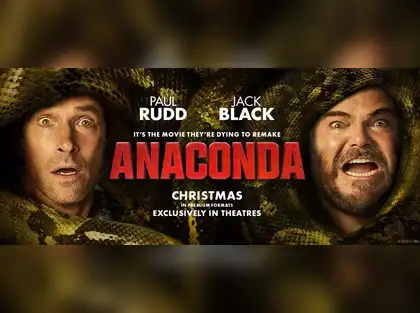
The snake serves more as a narrative symbol than a pure source of fear.
Fear Takes a Back Seat
The snake itself — inevitably compared to both the 1997 original and today’s CGI standards — is serviceable rather than spectacular. The filmmakers seem less interested in terror than in what the creature represents: the enduring grip of nostalgia and the absurdity of reboot culture.
Viewers hoping for relentless suspense may find the film frustratingly tame. Tension rarely sustains itself for long before being undercut by humor or self-referential commentary.
A Commentary on Hollywood Nostalgia
Where Anaconda (2025) succeeds most is in its commentary on why reboots exist at all. The film understands that many revivals are driven less by storytelling necessity and more by audience craving for familiarity.
It pokes fun at that impulse while indulging it, resulting in a balancing act that feels clever yet occasionally conflicted. At times, the movie seems unsure whether it’s critiquing Hollywood’s recycling habits or happily benefiting from them.
Final Verdict
By the final act, Anaconda fully embraces its identity as a comedy first and a monster movie second. The climax favors spectacle and satire over fear, closing on a note that feels celebratory rather than suspenseful.
In the end, Anaconda (2025) isn’t about resurrecting a killer snake — it’s about examining why we keep resurrecting old stories. It’s breezy, self-aware, and powered by two charismatic leads who understand exactly what kind of movie they’re in.
For fans of Jack Black and Paul Rudd, it’s an easy recommendation. For horror purists, it may feel like a missed opportunity. But as a commentary-driven reboot that embraces humor, nostalgia, and controlled chaos, Anaconda proves that sometimes the smartest way to revisit the past is not to take it too seriously.























Comments