Benin Military Uprising Crushed After Rebel Soldiers Briefly Seize State TV
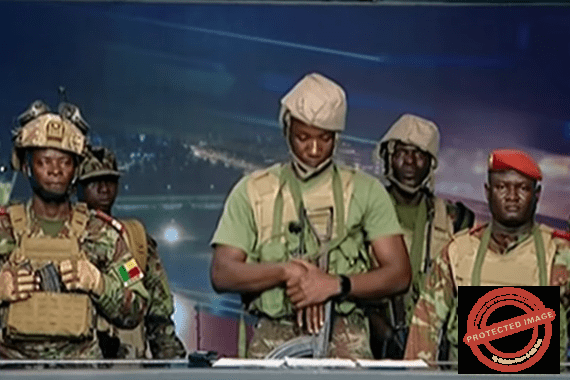
Loyalist troops retake control of the national broadcaster in Cotonou after a failed mutiny attempt by rebel soldiers.
Mutinous troops declared a takeover on national television before loyal forces swiftly intervened, restoring civilian rule and arresting the plotters.
Benin Republic — long viewed as one of West Africa’s more stable democracies — was jolted in the early hours of Sunday when a small faction within the military attempted to overthrow the government. The abrupt mutiny sparked fear and confusion across the capital, as rebel soldiers stormed the national broadcaster, made sweeping declarations of power, and announced the removal of President Patrice Talon from office.
The dissidents, calling themselves the “Military Committee for Refoundation,” claimed responsibility for the takeover. In a brief but ominous televised message, they announced the suspension of the constitution, dissolution of all state institutions, closure of national borders, and the installation of a new military leadership headed by Lieutenant Colonel Pascal Tigri. According to their proclamation, this drastic intervention was justified by worsening national security and failure of the government to protect both citizens and frontline soldiers deployed in volatile northern regions.
The soldiers alleged that successive administrations had neglected frontline troops, leaving fallen soldiers’ families uncompensated and ignoring the welfare of forces engaged in ongoing counter-insurgency operations. They painted their mutiny as a last resort — a desperate attempt to “restore dignity and security” to the nation and its armed forces. But even as their message resonated with underlying grievances, many observers noted the group’s limited capacity: they controlled only the national broadcaster, not strategic military bases or critical infrastructure.
As the broadcast played across TV channels, residents of Cotonou reported hearing gunfire near the presidential residence. Panic quickly spread: streets emptied, shops closed, and social media exploded with rumours. Foreign embassies reportedly issued internal security alerts. For a time, the unrest threatened to engulf the city in chaos.
However, by late morning, loyalist forces had mobilized and retaken control. Key installations — including the state television station — were secured. The rebel broadcast was taken off-air and replaced with looping visuals of the national flag accompanied by patriotic music. In a press statement, the Minister of Interior, Alassane Seidou, confirmed that the mutiny had been broken and reaffirmed that President Talon remained in power.
Describing the attempted takeover as “the work of a small, misguided minority,” the minister affirmed that the majority of the armed forces remained loyal to the republic. He thanked loyal units for their quick response and urged calm among citizens, assuring them that security had been restored and that order would prevail.
Security services announced at least a dozen arrests: active-duty soldiers identified as participants in the takeover, alongside at least one retired officer suspected of helping coordinate the plan. Authorities opened a full investigation, stating it would be thorough and transparent. More arrests, officials warned, could follow — especially if evidence pointed to civilian collaborators or external instigators behind the mutiny.
Analysts examining the failed coup highlighted several factors explaining its collapse. First, the plotters lacked broad military support: they seized only the national broadcaster, neglecting strategic targets such as the presidential palace, major barracks, or the international airport. Their apparent isolation made it relatively easy for loyalist forces to encircle them and neutralize the attempt. Second, the rapid intervention and unified command structure among loyal troops prevented escalation into full-blown civil conflict. No widespread fighting outside the initial skirmish was reported, and the transition back to normalcy was remarkably swift.
Yet the attempted coup did more than fail — it exposed structural vulnerabilities in Benin’s political and security landscape. The motivations cited by the mutineers — concerns about soldier welfare, dissatisfaction with military leadership, and frustration over persistent insecurity — echo grievances long whispered in barracks and among veteran families. The fact that those grievances were enough to spark an armed mutiny highlights the urgency of addressing systemic neglect and mismanagement within the military.
Politically, the timing of the upheaval is particularly sensitive. Benin is preparing for presidential elections scheduled for April 2026. Although President Talon’s second term is ending and he is expected to step down, the election atmosphere is increasingly fraught. Several opposition hopefuls have been disqualified by the electoral commission, prompting accusations that the government is tightening its grip on power. Earlier this year Parliament extended the presidential term from five to seven years — a move critics argue undermines democratic norms, even though it retained the two-term limit.
In this climate of uncertainty, the attempted mutiny may serve as both symptom and warning. For the mutineers, it was a protest born of frustration and desperation. For many citizens, it marks an alarming reminder that democratic gains are precarious when institutional trust erodes. Whether it signifies emerging threats — internal or external — to Benin’s democratic order remains unclear, but the implications are real and wide-ranging.
Regional reactions were swift. The :contentReference[oaicite:0]{index=0} (ECOWAS) condemned the uprising, reaffirming its commitment to democratic governance and constitutional order. The :contentReference[oaicite:1]{index=1} (AU) echoed the condemnation, warning that military interference in politics undermines hard-won stability across the continent. Both blocs urged restraint, urging all parties to respect civilian rule and promising to support efforts to restore peace and safeguard democratic institutions.
International media coverage underscored the broader regional significance of the failed coup. Many analysts pointed out that in a region already riddled with junta-led governments, even a momentary slide into military takeover in Benin — long considered a democratic outlier — suggested that no country is immune from institutional fatigue, security pressures, and political frustrations. The event has reignited debate about the stability of governance in West Africa and the fragility of democratic norms under stress.
On the domestic front, citizens reacted with a mixture of relief, fear, and skepticism. Some hailed the rapid restoration of order as proof of institutional resilience. Others expressed concerns about lingering distrust within the military, the possibility of further attempts, and whether the government would seriously address the grievances raised by the mutineers. Social media remains rife with speculation, suspicion, and demands for transparency — especially around who ordered the mutiny, who funded it, and whether it was purely a military revolt or had political backing.
Looking ahead, the government faces a difficult balancing act: restoring public confidence while addressing the root causes behind the mutiny. That includes serious reviews of military welfare, veteran compensation, promotion policies, and the chain of command. Analysts recommend broad reforms aimed at improving transparency and accountability within the armed forces, alongside efforts to improve security across troubled northern regions. Failure to act, they warn, could leave the country vulnerable to further unrest.
Moreover, with elections just months away, expectations are high. Civil society groups, opposition figures, and ordinary citizens alike are calling for a credible and inclusive electoral process. Many argue that the election must be accompanied by reforms guaranteeing equal opportunity for all candidates, protection of civil liberties, and measures to strengthen democratic institutions. The recent coup attempt, they argue, should serve as a wake-up call rather than be swept under the rug.
For now, daily life in Cotonou has returned to a semblance of normalcy. Businesses are operating, traffic flows, and people move about cautiously but peacefully. Security checkpoints and patrols remain in place, but widespread panic has subsided. At the same time, the atmosphere is tense, as citizens wait to see whether investigations will lead to accountability, and whether the government will respond to the deeper problems revealed by the uprising.
In the final analysis, the failed mutiny marks a crossroads in Benin’s contemporary history. The quick restoration of civilian rule demonstrates that institutions still function under pressure. But the mutiny itself — no matter how brief or ill-fated — signals that underlying tensions run deep. Whether the republic emerges stronger, more transparent, and more responsive to its citizens — or drifts toward further instability — may hinge on the choices its leaders make now.
By Ekolense International News Desk

















Comments