Putin’s India Visit Signals Strategic Reset as New Delhi Balances U.S. Tensions and Global Power Shifts
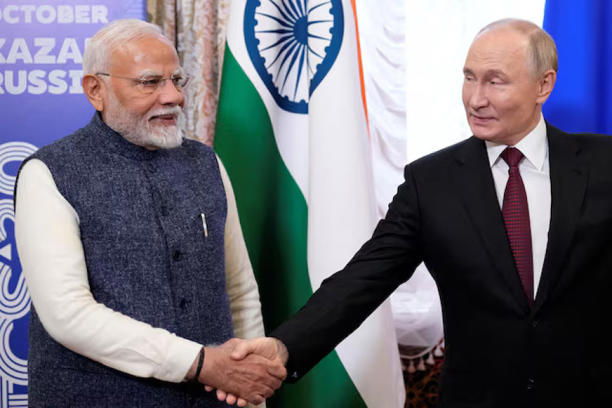
Russian President Vladimir Putin attends a two-day summit in New Delhi, marking a key moment in India–Russia relations.
The Russian President arrives for a two-day summit as India asserts strategic autonomy amid strained ties with Washington, rising energy stakes, and shifting global alliances.
Russian President Vladimir Putin is set to arrive in India on December 4–5 for the 23rd annual bilateral summit, marking his first trip to New Delhi since the start of the Ukraine war. The summit, established in 2000 and elevated in 2010 when both countries defined their partnership as a “Special and Privileged Strategic Partnership,” comes at a sensitive geopolitical moment—India’s relationship with the United States is cooling, while global alignments remain in flux.
For New Delhi, this visit is not just another diplomatic engagement. It is a deliberate reaffirmation of a longstanding partnership at a time when India is asserting its strategic autonomy more openly than at any point in the post–Cold War era.
Oil, Pressure, and Independence
India’s continued purchase of discounted Russian oil has attracted sharp criticism from Western capitals, especially Washington. White House deputy chief Stephen Miller escalated the rhetoric this year by accusing India of “funding the war in Ukraine.” Trump-era tariffs—raised sharply to 50 percent in August—further strained ties.
Yet India maintains that its foreign policy is driven solely by national interests. After caving to U.S. pressure and stopping oil imports from Iran, New Delhi sees Russian crude as a lifeline for its expanding economy. The numbers tell the story: Russian oil constituted just 2 percent of India’s imports in 2022. By the 2024–25 financial year, it soared to 35.8 percent.
Cheap energy has become one of the core pillars of India’s economic strategy, and Russia, despite being sanctioned globally, occupies a central role in that calculus.
Historical Memory and the Shifting Global Order
The Soviet Union’s legacy as a steadfast partner continues to shape India’s political consciousness. Although younger generations may not share the deep Cold War memory, recent U.S. behavior has revived old anxieties.
Trump’s transactional diplomacy, coupled with Washington’s warming ties with Pakistan—particularly during and after Operation Sindoor—has been interpreted in New Delhi as a reminder of America’s fluctuating reliability. The quick embrace of Pakistan’s Field Marshal Asif Munir has not gone unnoticed either.
Even as India and the U.S. have institutionalized cooperation through mechanisms such as the 2+2 Ministerial Dialogue, Indo-Pacific coordination, and expanding defence ties, frictions have resurfaced. U.S. tariffs and public pressure regarding India’s relationship with Russia have contributed to a growing sense in New Delhi that Washington’s expectations do not align with Indian strategic culture.
External Affairs Minister S. Jaishankar captured this sentiment succinctly when he described India–Russia relations as “one constant in world politics,” even as the world undergoes profound shifts.
Multi-Alignment, Not Non-Alignment
Despite border disagreements with China and ongoing friction in Ladakh, India has chosen a realistic approach—keeping diplomatic channels open with Beijing while pursuing its own strategic path. This differs sharply from the American narrative that lumps Russia and China together as adversarial powers.
India’s participation in BRICS and the Shanghai Cooperation Organisation—often dismissed in Western commentary as “anti-West” blocs—reflects its broader commitment to multialignment. New Delhi seeks leverage and flexibility, not alignment with a single camp.
Putin’s visit fits squarely into this philosophy. The meeting is expected to energize a relationship that has experienced logistical and sanctions-related disruptions in recent years, particularly in defence trade.
The Economic and Trade Landscape
Although India–Russia trade has surged, it remains heavily imbalanced. From a modest USD 1.4 billion in 1995, bilateral trade ballooned to USD 68.7 billion in 2024–25, driven primarily by Russian oil. India’s exports, however, were just USD 4.88 billion.
Sanctions have pushed both countries toward settling transactions in national currencies. To support this, the Reserve Bank of India has simplified the rupee-vostro framework, allowing foreign banks to hold rupees and invest them in Indian government securities and treasury bills. This lays the foundation for deeper trade ties insulated from Western financial systems.
During the summit, both sides are expected to address New Delhi’s concerns about the widening trade deficit. India has outlined 65 non-tariff barriers that complicate access to Russian markets. Energy cooperation—especially in nuclear technology—could be a significant focal point. Russian state corporation Rosatom has proposed developing small modular nuclear reactors in India, supporting New Delhi’s push toward cleaner, greener energy sources.
Defence Ties: Strengths, Stresses, and Red Lines
Russia remains a crucial defence partner despite India’s diversification toward Western suppliers. Russian equipment constitutes a major share of India’s military inventory, and joint projects like the BrahMos missile—used operationally during Operation Sindoor—are central to India’s defence capabilities.
Defence Minister Rajnath Singh’s meeting with Russian Defence Minister Andrey Belousov in Qingdao earlier this year underscored India’s priorities: ensuring timely delivery of S-400 air defence systems delayed by the Ukraine conflict, upgrading its fleet of Su-30 MKIs, and securing critical spare parts and components.
But there are areas of tension. Reports that Russia might supply RD-93MA engines to Pakistan—denied by Moscow—sparked alarm in New Delhi. Russia’s arms exports to China, which could indirectly benefit Pakistan’s JF-17 upgrades, also remain a sensitive issue.
Still, signs suggest Moscow is attuned to India’s concerns. India’s consistent refusal to bow to Western pressure and its refusal to condemn Russia on Ukraine has strengthened trust. The first India–Russia 2+2 dialogue in 2021 laid the foundation for deeper coordination, and this summit could revive that momentum.
Afghanistan, Regional Security, and Shared Interests
Moscow’s engagement with India in Afghanistan—through the Moscow Format created in 2017—demonstrates shared security interests. India, initially represented at a non-official level, eventually joined formal meetings alongside the Taliban in 2021.
India’s participation in the Russia-Iran-India troika following the U.S. withdrawal highlights its intent to remain a relevant player in Afghanistan’s evolving landscape. Moscow, despite maintaining communication with Islamabad, understands India’s stakes more deeply.
Ukraine Peace Plan and a Divided World
Putin’s visit comes as Moscow evaluates the U.S.-backed peace plan for Ukraine. India—maintaining cordial ties with both Kyiv and Moscow—has walked a delicate line throughout the conflict, calling for diplomacy while refusing to take sides.
The summit will likely include discussions on the future of the Ukraine conflict, NATO expansion, European security, international sanctions, and Russia’s deepening ties with China. India is watching closely. The outcome of the peace plan could reshape Europe, Russia’s long-term strategy, and global energy flows—all areas that directly influence Indian foreign policy.
A Visit with Consequences
Putin’s trip to India is far more than a symbolic gesture. For Russia, India is a crucial market, a strategic partner outside the Western bloc, and an influential actor in Asia. For India, Russia remains a steady defence supplier, a key energy partner, and an essential pillar of its multi-aligned diplomacy.
As global politics grow more polarized, India continues to chart its own path—refusing to fall neatly into any geopolitical “camp.” Putin’s visit underscores that New Delhi sees value in maintaining strong ties with Moscow, even as it navigates difficult waters with Washington, Beijing, and the wider international community.
The summit may not produce headline-grabbing breakthroughs. But its real significance lies in reinforcing a relationship that has endured ideological shifts, economic transitions, and global crises—and still remains one of the most consequential partnerships in India’s foreign policy.
By Ekolense International News






Comments