Death Toll in Hong Kong High‑Rise Blaze Climbs to 128 as City Reels from Disaster
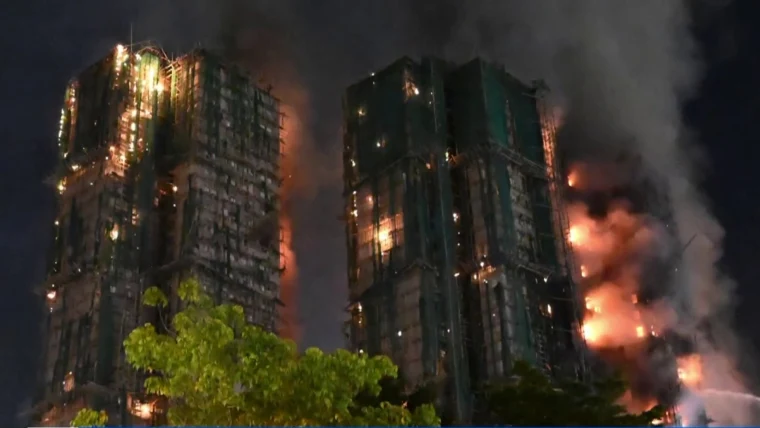
Flames engulfed Wang Fuk Court in Tai Po, Hong Kong, in one of the deadliest residential fires in the city’s history.
A midday fire at Wang Fuk Court in Tai Po erupted into one of the deadliest residential disasters in Hong Kong’s history — destroying lives, homes and faith in public safety, as grief and outrage grip a shaken city.
On the afternoon of 26 November 2025, life at Wang Fuk Court — a housing estate nestled in the Tai Po district of Hong Kong’s New Territories — turned from ordinary routine into unthinkable horror. At approximately 14:50 HKT, the first spark ignited on the bamboo scaffolding wrapped around one of the estate’s towers undergoing renovation. Within minutes, the building’s protective netting went up in flames. What began as a localized fire transformed, with shocking speed, into a towering inferno that would engulf seven of the complex’s eight high‑rise blocks.
As smoke curled into the sky and flames licked the building’s facade, panic erupted across the estate. Residents — many elderly or with limited mobility — scrambled desperately to escape. Corridors filled with thick, acrid smoke. Elevator access failed. Fire alarms reportedly did not sound.
Calls flooded the emergency lines. Neighbours pounded doors in vain. Families held their children close, tried to guide one another down cramped stairwells, or frantically searched for any possible exit — but many found none. The fire spread with ruthless speed, aided by flammable netting and foam‑sealed windows added during renovation works.
By 18:22, officials had upgraded the incident to a “level‑5 alarm” — the highest emergency classification in Hong Kong’s fire‑response system. Within hours, dozens of fire trucks, ambulances, and nearly 800 firefighters were deployed as the blaze raged across multiple towers. Roads were shut. Nearby highways were closed. Bus routes diverted. Residents fled to temporary shelters.
But the rescue efforts faced nightmarish hurdles. The bamboo scaffolding — once intended to support renovation — collapsed in places. Falling debris and scorching heat forced firefighters to rely on ladder trucks and external water jets to reach upper floors. Inside, thick smoke and deadly heat made internal entry nearly impossible. Many residents trapped above the flames had no chance.
Some survived — a few elderly pulled to safety by neighbours, families clutching each other as they fell from windows into nets or onto ladders, domestic workers cradling children as they descended. But for many others, there was no escape.
Over the next 48 hours, a grim tally emerged: 128 confirmed dead, including one firefighter, and dozens injured, several critically. As many as 200 people remained missing, their fate uncertain — feared lost in the smoke, buried under rubble, or trapped beyond rescue.
The human toll cannot be captured in numbers alone. Entire families vanished. People who had lived their lives in the same building — sharing meals, celebrations, memories — were gone within moments. Homes full of laughter turned to charred ruins. Personal belongings, photo albums, heirlooms — all reduced to ash.
At nearby community centres and malls, makeshift shelters sprouted overnight. Survivors — dazed, injured, traumatized — huddled on donated mats. Some held onto hope, clutching phones pleading for news. Others sank into despair, tears marking the faces of those who waited for loved ones who would never return.
“I heard nothing — no alarm, no warning,” one evacuee later said. “Then the smoke came, black and choking. I held my child tight and prayed.” Another recalled pounding on her neighbour’s door, shouting “Fire! Fire!” only to see flames lick through the netting outside moments later.
As the flames died down, attention shifted from rescue to reckoning. Investigators combed through debris. What they found shocked many: green mesh, plastic sheeting, polystyrene window coverings, scaffolding and exterior netting — materials that apparently failed to meet fire‑safety standards, but had been used anyway.
Three men — two directors and an engineering consultant from the construction firm responsible for the renovation — were arrested on suspicion of manslaughter. Authorities allege gross negligence, claiming that the choice of unsafe, flammable materials turned a renovation project into a death trap.
The city’s anti‑corruption agency also opened a full investigation into possible wrongdoing related to the renovation project — including whether cost‑cutting and corruption allowed sub-standard materials to be used.
For many in Hong Kong, this tragedy is more than a headline — it is a betrayal of trust. Residents say they had raised safety concerns before the works began; letters and petitions had gone unanswered. One government record from mid‑2024 described the fire risk at Wang Fuk Court as “relatively low,” a characterization now seen as painfully naive.
As the sun rose after the night of fire, survivors wandered among the blackened shells of their homes. A familiar skyline was now marred by grief. What had once stood as an emblem of safe, affordable public housing — where generations lived, children grew, elders spent their twilight years — was now a monument to loss.
Yet amid the ashes, small sparks of humanity emerged. Volunteers delivered blankets and food. Nearby hotels opened rooms for displaced families. Donations flooded in from across Hong Kong. Strangers embraced strangers. Communities bonded over shared sorrow — but also shared outrage.
People asked: How could this happen? Why were standard safety protocols ignored? How many more complexes use similar materials? Are our homes really safe?
Experts in fire safety and urban development weighed in swiftly. Many called for an immediate, sweeping reform: ban flammable netting and foam panels, replace bamboo scaffolding with fire‑resistant metal, enforce strict fire‑safety inspections on any renovation in high‑rise estates, and ensure functioning alarms and evacuation plans in every block.
Local authorities responded with promises: relief funds for victims’ families and displaced residents, mental‑health support, temporary housing, and a full inquiry into the renovation project — with consequences for those found responsible. But for many, such words come too late.
Hong Kong now stands at a crossroads. The tragedy at Wang Fuk Court may become a turning point — a moment that forces the city to face the cracks in its housing safety system. But for the families who lost loved ones, no reforms can reverse the night when home turned into a furnace, when safety became illusion, and when lives were extinguished in flame.
As mourning continues, a city searches for accountability. Grief lingers in streets once filled with laughter. Silence hangs heavy over ruined towers. And behind every number — every “128” — there is a story: a person, a family, a life cut short.
Wang Fuk Court will forever be etched in the memory of Hong Kong. But so too will the demand: that no home be allowed to burn again.
By Ekolense International News
Comments