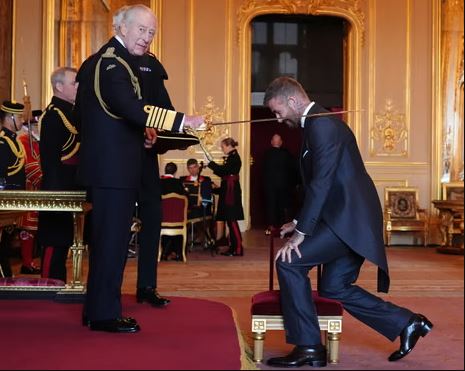
In a moment of national pride and celebration, football legend David Beckham has officially been knighted by King Charles III at a ceremony held in Windsor Castle. The honour, long anticipated by fans and admirers alike, recognises Beckham’s outstanding contributions to sports, philanthropy, and global goodwill over the last three decades.
Beckham, 50, arrived at Windsor Castle accompanied by his wife, Victoria Beckham, and members of his family, all visibly emotional as the ceremony unfolded. Dressed in a traditional morning suit, the former England captain was seen smiling broadly as the King placed the insignia of knighthood upon him.
For Beckham, the moment was a culmination of years of dedication both on and off the pitch. After receiving his Order of the British Empire (OBE) in 2003 from Queen Elizabeth II, many expected the next royal honour to follow soon. However, the journey to knighthood took longer than expected, as previous nominations were delayed due to administrative reviews and procedural issues.
Still, patience paid off — and now Beckham has joined the ranks of British sporting greats who have received the nation’s highest distinction. Speaking shortly after the investiture, he described the day as “the proudest of my life”, dedicating the honour to his parents, family, teammates, and fans around the world.
From his early years at Manchester United, Beckham became a symbol of excellence and passion. Under Sir Alex Ferguson, he rose from a promising academy player to one of the most recognised footballers on the planet. His stunning free kicks, precision passes, and flair on the field earned him admiration across continents.
Beckham’s football journey took him from Manchester to Real Madrid, LA Galaxy, AC Milan, and finally Paris Saint-Germain, where he retired in 2013. Over his 20-year playing career, he lifted numerous domestic and international trophies — including the Premier League, FA Cup, and the UEFA Champions League — and represented England in three World Cups, earning 115 international caps.
While Beckham’s sporting legacy is undeniable, his knighthood also reflects his decades-long humanitarian work. Since 2005, he has served as a UNICEF Goodwill Ambassador, leading campaigns focused on children’s health, education, and protection. He has also been a prominent supporter of malaria prevention initiatives and various UK-based youth development programs.
His 7 Fund for UNICEF, launched in 2015, has funded life-changing projects for vulnerable children in Asia, Africa, and Latin America. Speaking about his philanthropic mission, Beckham once said, “Football gave me a platform — and I believe it’s my duty to use that platform to make a difference.”
Beyond his athletic prowess and charitable work, Beckham has become a cultural ambassador for the United Kingdom. From his global influence in fashion and sports to his role as a co-owner of Inter Miami CF, he continues to shape both the game and the culture around it.
Even during his playing days, Beckham was seen as a bridge between sporting professionalism and celebrity culture — inspiring young players while representing his country with class and humility.
Royal watchers and fans alike see this knighthood as more than a ceremonial title; it’s a symbol of enduring service, discipline, and national pride. The King’s decision to bestow the honour reportedly reflected not only Beckham’s achievements in football but his ongoing commitment to humanitarian values and community leadership.
Now formally Sir David Beckham, the icon’s influence stretches far beyond the football field. He continues to advocate for youth empowerment, environmental awareness, and ethical sports development worldwide. For many, his story — from an East London boy with a dream to a global icon — remains one of inspiration, perseverance, and purpose.
As he stood before King Charles III at Windsor Castle, there was no mistaking the symbolism of the moment: a boy who once played on the streets of Leytonstone had become a man honoured by the Crown — not just for his fame, but for his service.
By Ekolense International Desk